
The Invisible Machine
I built a living visualization of one of the most complex systems on the internet.

The internet is one of the most complex systems humanity has ever built. It serves billions of people every day — routing requests across continents in milliseconds, coordinating trillions of interactions, running the financial and social infrastructure of the modern world.
It is humanity’s primary coordination layer. And almost none of it is visible. What happens behind apps, websites, and loading spinners remains, by design, invisible.
Blockchains are perhaps the most sophisticated layer of that infrastructure. Cryptographic consensus across hundreds or even thousands of geographically distributed nodes. Parallel processing handling different slices of global state simultaneously. Transactions that originate in one part of the network and execute in another, coordinated by a system that nobody controls. It’s genuinely remarkable engineering — and it looks, to almost everyone, like a price chart.


That perception gap is one of the reasons so few people engage with the underlying technology. So I built something to close it.
The Information Universe
Galaxy of Nodes reimagines the MultiversX blockchain as a living system — a network you can rotate, zoom into, and watch think in real time.
MultiversX is a fully sharded blockchain: the network is divided into three parallel processing shards, each handling its own slice of transactions simultaneously, coordinated by a central metachain. It’s an architecture that allows the network to scale horizontally as demand grows — more shards, more throughput — while maintaining a single coherent state. Nearly 3,000 validator nodes keep it running, distributed across those shards, each one staking the native EGLD token as a guarantee of honest participation.
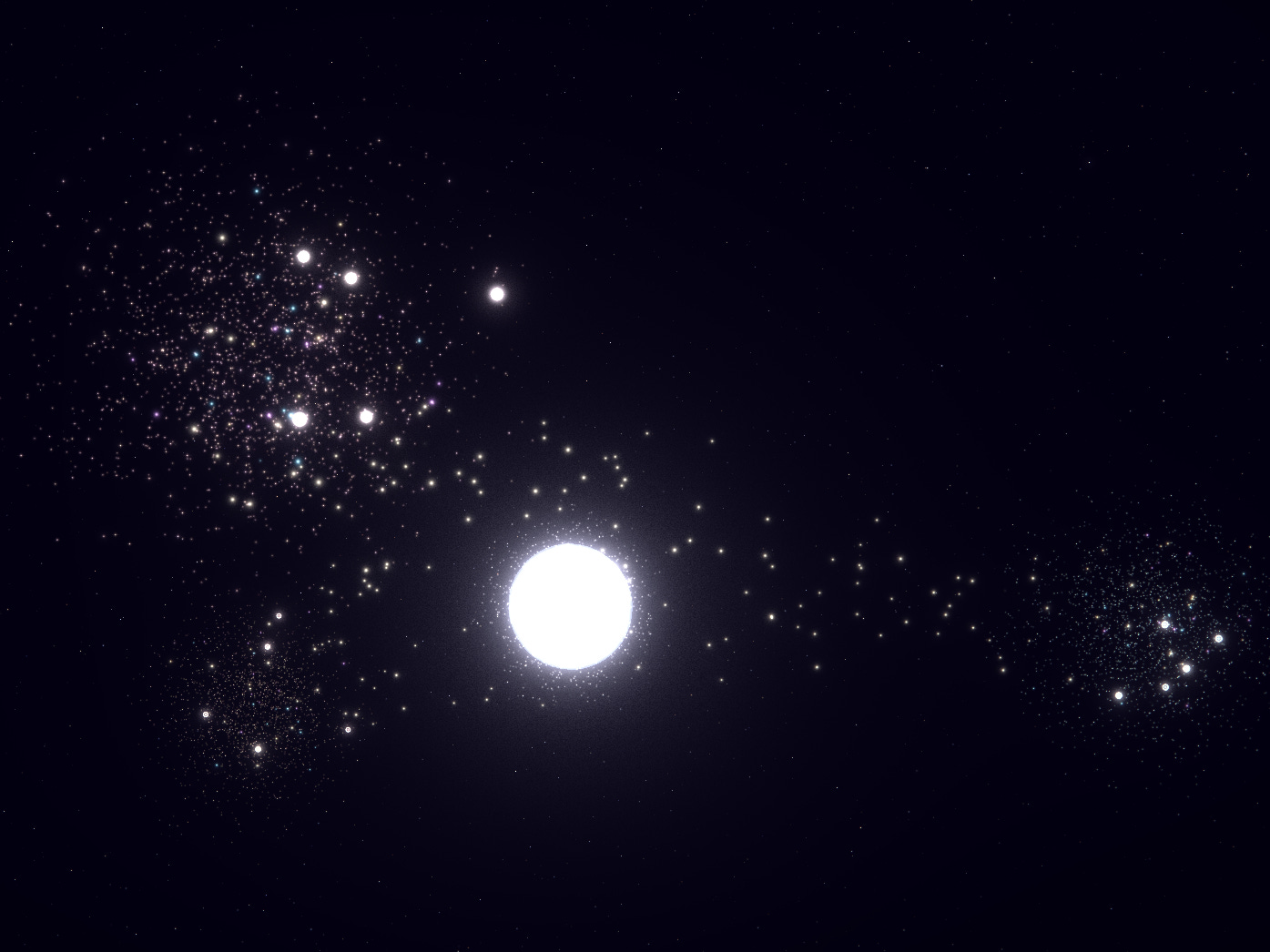
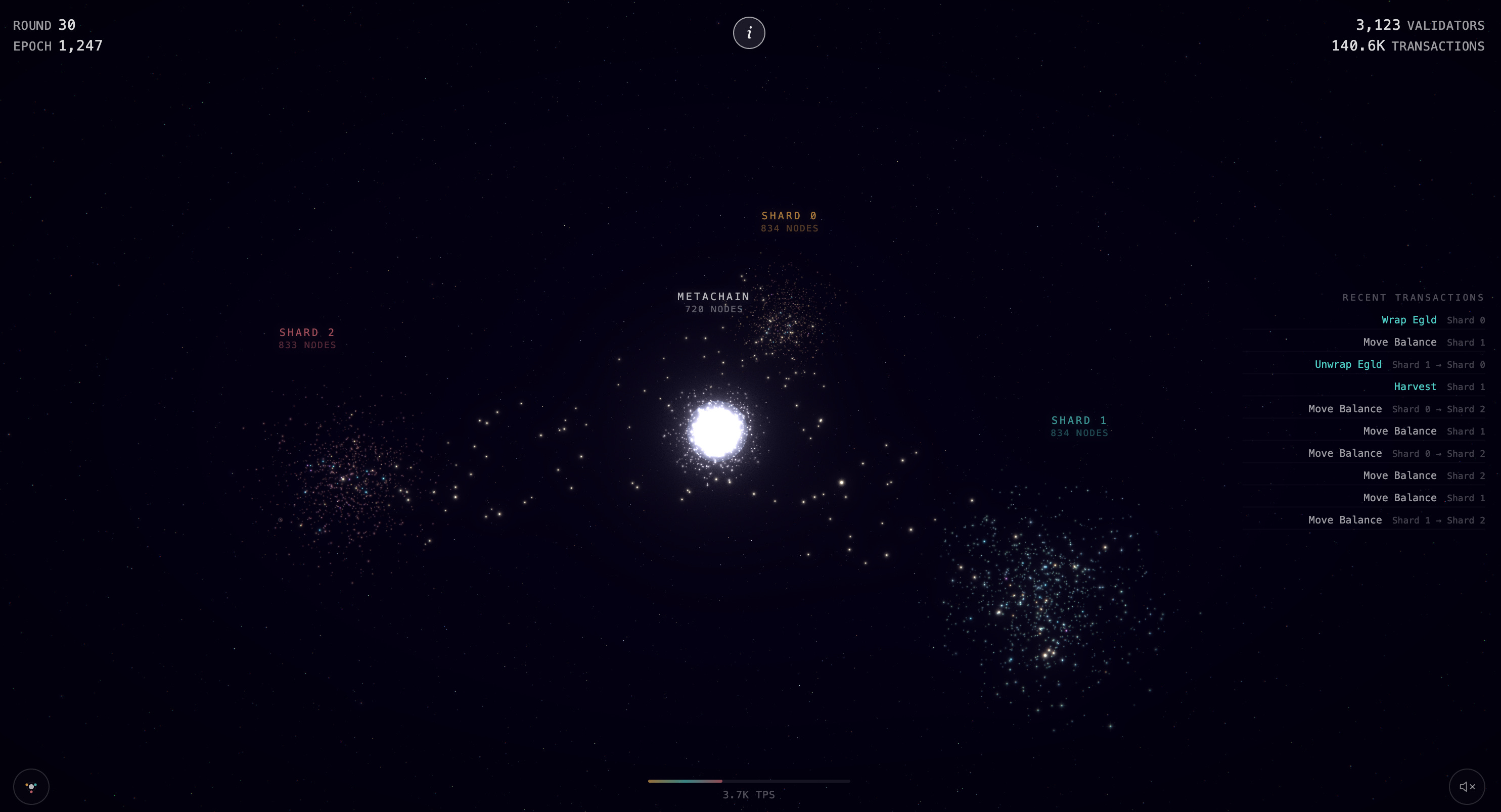
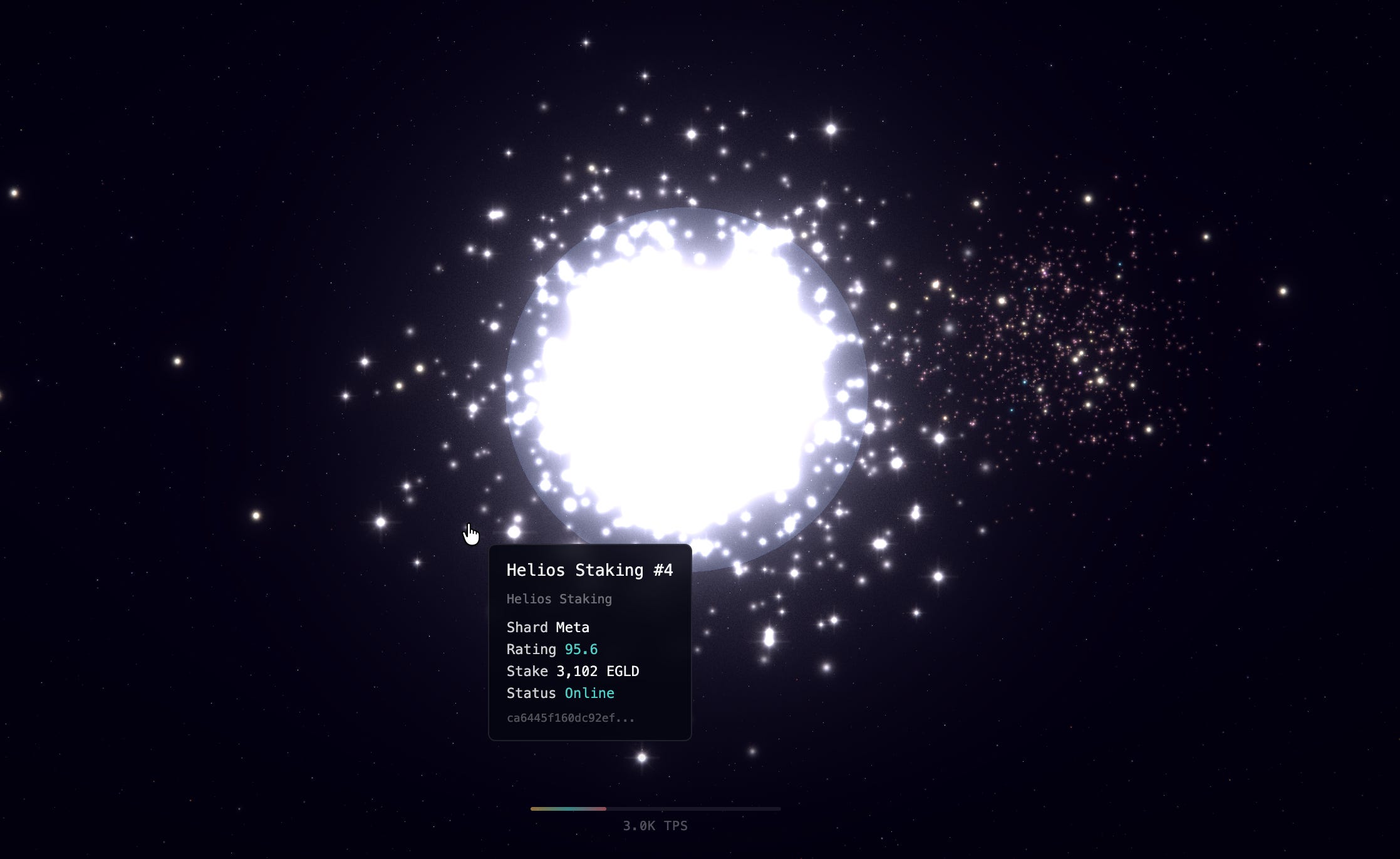
In the galaxy, the metachain is the gravitational core — a white-hot mass at the center, pulsing each time it produces a block. The three shards are star clusters orbiting it. Each validator is a star. Each transaction is light.
What You Are Looking At
Stars — each one is a real validator node. Brightness maps to its reliability rating; size maps to its stake. The most trusted, most committed validators burn brightest. When a validator is selected to propose a block, it flares briefly — a ring of light expanding outward.
Particles — each one is a real transaction, classified by type. Warm gold for EGLD transfers. Cyan for smart contract calls. Purple for ESDT token transfers (custom tokens like USDC or MEX). Cross-shard transactions — where value moves from one shard’s processing lane to another — travel in white, arcing through the metachain region. High-value cross-shard transactions carry a comet tail: two trailing particles, because something significant is moving and it should look that way.
The clusters breathe — each shard oscillates slowly in brightness at its own frequency, never synchronized with the others. It’s a small thing, but it’s what makes the difference between a data visualization and something that feels alive.
All of it is a live feed. The validator count in the top right, the transaction total, the TPS bar at the bottom — that’s the actual network computing vast amounts of data at 600ms per block.
For the Technically-Inclined
The rendering engine is Three.js (r183) with custom GLSL shaders handling the stellar glow, diffraction spikes, and per-star twinkle. Validators are rendered as GPU-instanced points — 3,200+ of them, plus 80,000 background stars and 3,000 ambient dust particles drifting between clusters. Post-processing runs bloom, chromatic aberration, film grain, and color grading in real time via a WebGL pipeline. Transaction particles use object pooling across an 800-slot pool so performance stays smooth under load. The whole thing is built on a DataSource interface that abstracts mock vs. live data behind a single URL parameter — same rendering pipeline, two completely different inputs.
The MultiversX team built a public API that made the live integration possible: validator registry, transaction feed, block events, and network stats, all accessible and well-structured enough to map directly onto the visual layer.
I built this with Claude Code. No professional engineering background — just a clear vision of what I wanted and the ability to describe it precisely. If that sounds interesting, I wrote about the shift it represents and how you, too, can do this here.
The code is open source. If you want to add features, clone it for your own chain, or just take the rendering pipeline somewhere else, go ahead (and send me the result, I’d love to see it).
Blockchain Is Beautiful
The goal was not to build another blockchain dashboard. It was to close the gap between what these systems actually do and what most people ever get to see of them.
Complex infrastructure doesn’t have to be invisible. It can be made visible — and when the underlying architecture is this interesting, it can be made beautiful.
Explore the Galaxy of Nodes.
The network you are looking at is in the middle of something significant. MultiversX is currently running Battle of Nodes — a public stress test preparing the chain for Supernova, an upgrade that fundamentally changes the architecture to accommodate instant finality with a 10x increase in transaction speed. Galaxy of Nodes is already integrated with that live data. When Supernova goes to mainnet, this becomes the window into that moment: 3,000 validators, sub-second blocks, every transaction rendered as it happens.
Learn more about Battle of Nodes here.